Development
Integrations
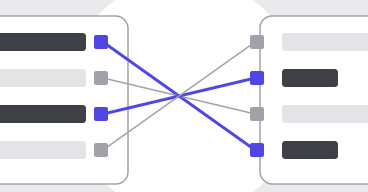
You stop moving data by hand. Payments, CRM, Telegram bots, delivery services and internal admin panels get connected through APIs, webhooks and background jobs.
- Reply to your brief
- within 24 hours
- First call
- 30 minutes, no commitment
- First working version
- in 7–10 days
Process
What happens, and when
The work is split into stages, and each one has a named result. You see it yourself rather than reading about it in a report.
Days 1–2
Mapping the process
We walk the process end to end with the person who runs it by hand: what gets moved where, how often, and what breaks when it does. What comes out of the first days is an order of work rather than a diagram — which link gets built first. First is the one that gets carried most often, because it shows fastest whether the rest is worth doing.
You get — An order of work and the first link
Days 3–5
Access and keys
This is where the real timeline shows up, and it is rarely ours. The other service has its own queue for access: whether there is a sandbox, who issues live keys and when. Until the keys arrive the exchange is built against stubs — the work continues, but the launch date belongs to whoever issues the keys, which is why the request goes in during the first days rather than once the code is done.
You get — A submitted key request and stubbed exchange
Week 2
Onto live data
The link goes onto live data — one direction first, at a small volume. The real work here is not the transfer but the repeats: another service will send the same event twice and stay silent the third time. The exchange has to survive that without creating a second order or losing the first.
You get — An exchange that survives repeats and silence
Before the switch
Running alongside
The manual step does not stop on launch day. For a week the exchange runs alongside the old way and the differences get worked through daily: a difference is more often not a bug but a rule that only the person moving the data knew. When the differences run out, the manual step goes.
You get — Differences worked through, the manual step gone
After launch
Log and alert
An integration never reaches a state of “done”: the other side changes an API version, a key expires, a new required field appears in a form. So the exchange keeps a log and a signal for silence — if events stop arriving, you hear it from the system rather than from a customer a week later.
You get — An exchange log and a silence alert
What the work covers
Mapping the process
which systems are involved, where data gets carried by hand, which steps have to be connected
Integrations with outside services
payment providers, CRM, partner and third-party APIs
Webhook exchange
taking in events from other services and sending your own, one shape for the response and one for the error
Queues and background jobs
workers move the data in the background, instead of a person moving it in an interface
Access inside the internal tool
roles, who may see and change which records, sign-in over JWT or OAuth
Documentation for the exchange
endpoints written up in OpenAPI, sample requests, a Postman collection on request
What we need from you
- The systems to be connected, and what happens between them today
- Keys and accounts for those systems, plus whatever documentation their APIs have
- The person who owns the process: someone to ask why a step works the way it does, and who checks the result against it
Projects in this area
Insurance
Klarim
Reads the scanned pack behind an insurance claim: finds the fields in certificates, photos and statements and moves them into the claims system.
40 → 6 minutes
to process a single claim
Python · FastAPI · Anthropic API
Manufacturing
Naryado
A furniture plant where order, schedule and shipment travel under one number, and five systems already in place exchange data through the loop instead of spreadsheets.
5 systems
running on a single order number
Python · PostgreSQL · Redis
What people usually ask
Contact
Send a description of the task
A reply with the scope, the timeline and a budget estimate comes within 24 hours.
The first call is 30 minutes, with no commitment on your side.
01
You describe the task
Five questions in the form, or a plain email — whichever suits you.
02
We answer within a day
With the scope, the timeline and a budget estimate, based on what you told us.
03
We talk for 30 minutes
To clear up whatever is unclear. It commits you to nothing.