AI solutions
AI for documents
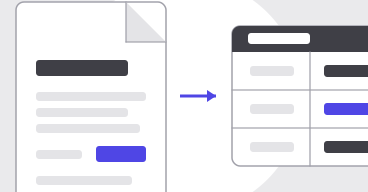
Documents without manual entry: invoices, contracts, statements and certificates become records in your system — fields, amounts and dates included.
- Reply to your brief
- within 24 hours
- First call
- 30 minutes, no commitment
- First working version
- in 4 weeks
Process
What happens, and when
The work is split into stages, and each one has a named result. You see it yourself rather than reading about it in a report.
Days 1–5
Your real intake
We take your real intake rather than samples: photos shot at an angle, scans of mixed quality, PDFs that turn out to be a picture inside. We count the document types and the fields people retype by hand today, and set part of the pile aside — quality is measured on it later, and it is never shown during tuning.
You get — Types, fields and a pile held back
Week 2
The target record
We describe the target record: which fields are mandatory, in what shape your system accepts them, what to do with a date written three ways and a total with and without tax. This is also where “uncertain” gets defined, and where an uncertain field goes — into a review queue, not into the database.
You get — The record described, with uncertainty thresholds
Weeks 3–4
Field extraction
Extraction is built in steps: the batch is split into documents, each document is typed, fields are pulled out, and every value is tagged with the place on the image it came from. We measure on the pile set aside, field by field — an overall accuracy figure hides the one field that is always wrong.
You get — Extraction with accuracy measured field by field
Before launch
Wired to your system
It connects to your system and review goes on: the operator sees the draft beside the scan and confirms it. Thresholds are set so that documents the pipeline will not take are handed over whole — an honest refusal costs less than a quiet error.
You get — A review screen writing into your system
The first month and beyond
Operator corrections
Operator corrections are the most valuable labelled data you will ever get: every one of them is folded into the pile quality is measured on, and the thresholds are revisited. A new document type, or a supplier who changed their form, shows up as a rise in refusals long before it shows up as a complaint.
You get — A growing test set and revised thresholds
What the work covers
Your real intake, not samples
an inventory of the document types and of the fields typed in by hand today, taken from the actual flow — phone photos, creased scans, PDFs with no text layer
The target record
the fields without which no record is created, one format for dates, totals and tax, the counterparty list names are matched against, and the test that marks a document as a duplicate
Pulling out the fields
splitting the batch into documents, typing each one, extracting values tied to their place on the scan — and settling whether a scan goes to the model whole or as de-identified text
The uncertainty threshold
every field gets its own threshold, below which a value queues for an operator instead of reaching the database; a document the pipeline cannot identify goes to a person whole
Accuracy field by field
measured on the part of your own intake that was set aside and never shown during tuning — one field at a time, because an average across a document says nothing about the field the whole thing was for
Wired to your system
a review screen with the scan and the draft record side by side, writing through an API or an export, and operator corrections folded back into the set quality is measured on
What we need from you
- A month or two of real documents, crooked scans and rare forms included, rather than ten good examples
- An operator on your side for the first weeks — to confirm the disputed fields and work through the refusals
- A decision on whether a scan goes out whole or only as de-identified text — it changes both the design and the price
What people usually ask
Contact
Send a description of the task
A reply with the scope, the timeline and a budget estimate comes within 24 hours.
The first call is 30 minutes, with no commitment on your side.
01
You describe the task
Five questions in the form, or a plain email — whichever suits you.
02
We answer within a day
With the scope, the timeline and a budget estimate, based on what you told us.
03
We talk for 30 minutes
To clear up whatever is unclear. It commits you to nothing.