Product launch
End-to-end MVP
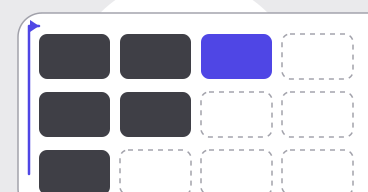
From idea to a launched MVP in 4–8 weeks. What goes into the first version and what waits for the next is settled before the start. The architecture is built to grow after release.
- Reply to your brief
- within 24 hours
- First call
- 30 minutes, no commitment
- First working version
- by the end of week 4
Process
What happens, and when
The work is split into stages, and each one has a named result. You see it yourself rather than reading about it in a report.
Days 1–7
Scope of version one
We cut what you have in mind in two: the journey the product makes no sense without, and everything else. Everything else is not thrown away, it becomes the list for the next version — and later that list shows exactly what you did not pay for in month one.
You get — The core journey and the next-version list
Weeks 2–3
Modules and data
We set the module boundaries and the data model so that a hypothesis which fails changes one module rather than the whole product. This is also where it is settled what the admin panel can do and which API the client needs — web or mobile.
You get — Module boundaries, data model and the chosen API
Weeks 3–6
The main journey
We build the main journey whole rather than in pieces: by the end of week four you can create an account on the test server, take the journey to its end and see the result in the admin panel. Everything else is built around it.
You get — The whole journey on the test server
Weeks 7–8
The production server
The move to the production server: Docker and NGINX, certificate, automated builds. Logs and monitoring go on the same day — in a first version a breakage usually shows up on the error graph rather than in an email from a user.
You get — A live environment with logs and monitoring
After launch
Rebuilding the plan
Real users show which of the guesses held. The list parked in the first stage is rebuilt around what the logs and the behaviour show — the second version is no longer built out of assumptions.
You get — A next-version list rebuilt from the logs
What the work covers
Scoping
going through the task, clarifying the requirements and analysing the risks before the work starts
An architecture plan
what the product is made of, where the boundaries between modules run, what gets added after the first release
The core modules
the journey the product launches for, an API for the web or mobile client, an admin panel to run it from
The data model
entities and relations shaped by what the product does, laid out to survive the changes that follow the first release
Going live
Docker and NGINX, SSL, deployment to a server or to the cloud, basic CI/CD
Logging and monitoring
what the server is doing, and where it stopped doing it
What we need from you
- The idea and the journey it launches for — or a written spec, if one already exists
- Your server and domain with credentials, if that is where the product goes live
- Someone who watches the work as it lands and says what happens next
What people usually ask
Contact
Send a description of the task
A reply with the scope, the timeline and a budget estimate comes within 24 hours.
The first call is 30 minutes, with no commitment on your side.
01
You describe the task
Five questions in the form, or a plain email — whichever suits you.
02
We answer within a day
With the scope, the timeline and a budget estimate, based on what you told us.
03
We talk for 30 minutes
To clear up whatever is unclear. It commits you to nothing.